HOME
SWITCH TO SOLAR, STOP OVERPAYING FOR YOUR ELECTRICITY
COMMERCIAL SOLAR INCENTIVES, 30% INVESTMENT TAX INCENTIVE, AND MORE UNTIL 2027
RESIDENTIAL SOLAR,
THIRD PARTY OWNERS (TPO) MAY LEASE YOUR ROOF
MANY LOCAL INCENTIVES
The landscape of solar energy incentives is rapidly evolving, bringing fresh opportunities, new challenges, and critical information that every solar advocate, business owner, and industry professional should know. Federal subsidies are rapidly disappearing. Subsidies for EV chargers, critical in the growth of the EV transport sector, will end June 30, 2026. This makes it an ideal time to purchase an EV Charger, as the status quo of chargers should remain the same for a number of years going forward after June 30, 2026. The current admistration anti-science policies is gravely hurting the United States, and our focus in the following pages explains our position.


The Future of Data Belongs in
the Fields, Not the City
Something is breaking down at the heart of America's digital infrastructure. Cities are saying no. Atlanta banned new data centers near transit hubs and the Beltline. In Monroe County alone, more than 900 residents showed up to oppose a single rezoning application. Across Georgia and the Carolinas, billions of dollars in proposed data center projects have been blocked, delayed, or driven out entirely — not by bureaucracy, but by communities that simply don't want them.

Bridging the Gap Between the Silicon
Chip and the Southern Soil
The demand for compute isn't going anywhere. AI is accelerating. Cloud workloads are multiplying. The world needs more data capacity, not less. The question isn't whether to build — it's where. And the answer is hiding in plain sight: the open fields of rural Georgia and the Carolinas, where land is available, sunlight is abundant, and communities are ready to welcome the right kind of development.
Solar DC Power is building that future. We develop solar-powered, agrivoltaic-fueled data centers on working farmland — where the same land that powers your servers also grows food, raises livestock, and supports independent farming families. Clean compute. Living land. This is infrastructure that actually serves the communities it touches.
Agrivoltaic Data Infrastructure
As reported by Kleinman Energy, agricultural land is well-suited for solar projects because it is often relatively flat, cleared of trees, exposed to the sun, and held in large parcel sizes. The U.S. Department of Energy has projected that utility-scale solar projects may provide as much as 45% of U.S. electricity by 2050, up from just 4% today. This growth in solar electricity will require as many as 10 million acres of land (U.S. DOE 2021). So far, agricultural land has been the site of about 83 percent of utility-scale solar development (Sorensen et al. 2022).
Agrivoltaics projects emit less greenhouse gases than separate solar projects and sheep grazing (Handler and Pearce 2022). Vegetation maintenance is important for solar production and grazing livestock, especially sheep and goats, can reduce or eliminate the need for mowing beneath and between the solar panels. Less mowing decreases greenhouse gas emissions and operating costs. The grasses planted for livestock become a source of nutrition and can improve soil quality and control erosion. Manure from livestock fertilizes the soil. Although livestock are a source of enteric methane, a potent greenhouse gas, sheep or goats raised in an agrivoltaic project produce roughly 25% less greenhouse gas emissions than conventionally grazed sheep. This reduction is due in part because the agrivoltaic sheep do not eat corn and soybean feed and herbicide use is lower or avoided altogether (Handler and Pearce 2022).
In addition, the solar panels provide shade for the grazing sheep, which can help regulate their internal temperature and potentially reduce their water needs. Also, the crops and grass under the solar panels keep the panels cooler, helping maintain the efficiency of the panels in turning sunlight into electricity. Pollinator habitat under solar panels fosters biodiversity as well as enabling pollinators to fertilize nearby crops.
Just 2% of agricultural land could produce as much as 45% of the energy used in the United States. When considering the benefits from Agrivoltaics, consider that 67% of agricultural land is used to grow transgenic crops that are sprayed with RoundUp multiple times, then mostly fed to animals eaten by people. This spraying, not just harmful to those that eat the animals, but also changes the Rhizoidal nature of the soil. Glyphosate can destroy or inhibit beneficial microorganisms in the soil. Specifically, it has been shown to be toxic to rhizobia, the essential bacteria responsible for nitrogen fixation in the soil.
The Problem We're Solving
Metro Atlanta is now the second-largest data center hub in the United States — and it's running out of runway. In 2024, the Atlanta City Council banned new data centers near the Beltline and MARTA transit corridors. Monroe County saw more than 900 residents turn out to oppose a single rezoning request. Neighboring counties enacted moratoriums. The resistance isn't political noise — it's a structural shift.
In the second quarter of 2025 alone, community opposition blocked or significantly delayed over $100 billion in data center projects across the country. The concerns driving that opposition are real: conventional data centers consume staggering amounts of water and electricity, displace housing and green space, and generate industrial traffic in places that weren't built for it. No one is wrong to push back.
But here's the tension no one else is addressing: the demand that's driving all this construction isn't slowing down. The rise of AI, cloud computing, and enterprise data storage means compute capacity must expand — and it must expand fast. Solar DC Power's answer is straightforward. Move data centers to where they're actually welcomed. Power them with the sun. Let the land do two jobs at once. No displacement. No opposition. No dead-end for the communities that host them.
Based on market research and search trend analysis, these are the questions People Also Ask:
- Why are cities banning data centers?
- Cities often oppose data centers due to intense strain on local infrastructure, specifically the massive consumption of water for cooling and electricity for operations.
2. What is agrivoltaics and how does it work?
- Agrivoltaics is the co-location of solar photovoltaic panels and agriculture on the same land, allowing for dual-use functionality—generating renewable energy while simultaneously farming crops or grazing livestock.
3. Can solar energy reliably power a data center?
- Yes. Solar DC Power recommends Storage Batteries in a solar system, and for back-up, on-site energy generation, Bloome's scalable NG modular fuel cells. Each data center analytics would determine final energy configuration.
4. How much can a farmer earn from a solar lease in Georgia?
- According to the Ag Economy Barometer, a survey by Purdue University and CME Group, 58% of farmers reported being offered annual payments of $1,000 or more per acre to lease their land for solar projects. In comparison, the average annual cash rent for farmland in Georgia in 2024 is $153 per acre. Since small family farms are more likely to face higher risk of financial instability, incorporating agrivoltaics can provide a more reliable, year-round income stream than traditional farmland alone.
5. What is the difference between a solar farm and an agrivoltaic farm?
- A solar farm generates electricity using ground-mounted panels, typically keeping the land clear of vegetation for maintenance. An agrivoltaic farm, or "agrisolar," intentionally co-locates solar panels with agricultural production (crops, livestock, or pollinator habitats), using elevated panels to allow farming underneath, boosting land efficiency and panel cooling.
6. Are rural data centers better for communities than urban ones?
- In addition to providing substantial tax revenue that can fund local services, construction of data centers can lead to improved broadband, fiber connectivity, and power infrastructure, potentially benefiting the broader community.
7. How do agrivoltaic solar panels affect crops and livestock?
- Agrivoltaic solar panels boost crop yields and water efficiency by creating cooler, shaded microclimates that reduce plant heat stress and soil moisture evaporation. Livestock, particularly sheep, thrive by grazing on vegetation beneath panels, which provide shade and shelter while reducing maintenance costs for operators.
8. What are the environmental benefits of rural solar data centers?
- Rural solar data centers offer significant environmental benefits by combining renewable energy generation with sustainable technology, reducing the carbon footprint of the rapidly growing digital infrastructure sector. By co-locating farming and energy generation, Agrivoltaics. electricity will be less expensive and save centers millions of dollar orver each decade. Decentralizing energy will bring a level of security hereto unknown. However, if data centers chose to use grid electricty, they will impose an enormous burden on the comunity, whether rural or urban. Under this scenario, there will be stiff opposition to acceptance into the community.
9. How long does it take to build a solar-powered data center?
- It takes 3 to 5 years to build, assuming average weather prior to being Dried-in. Construction of on-site energy generation and water cooling infrastructure can be finished in less than 1-year.
Solar DC Power specializes in Commercial Solar and Residential Solar, and climate change infrastructure, including EV chargers and scalable Storage Batteries, Microgrids and Agrivoltaics. Due to differences between the two, we work on different virtual platforms —residential and commercial —and with corresponding Groups: Surge for commercial projects and Powur for residential projects. Surge's Mission Statement is " to accelerate the transition to clean energy by connecting businesses and organizations with scalable solutions that lower costs, increase profitability, and reduce environmental impact". Surge's Mission Statement is similar, and Solar DC Power subscribes to both Mission Statements. Solar DC Power is taking an integral part in building infrastructure to build resilience to climate instability. Our access includes support from Surge's top Strategists. Our support companies have designed systems that can be installed on rooftops, ground mounts, or carports, in sizes ranging from megawatt utility-grade projects to 600 kW for Business Buildings, and even a 28 kW Juice Bar. With our collective, extensive experience, attention to detail, and focus on clients' desires, we customize solar systems that meet your unique energy needs, helping businesses, homeowners, and community organizations participate in the clean energy transition. Get a no-obligation preliminary offer based on current usage and a property analysis. This is the starting point with no money out of your pocket for a deep dive discovery call.

Bridging the Gap Between the
Silicon Chip and the Southern Soil
Solar DC Power proposal to mitigate growing opposition to data centers in urban areas, and locate DCs in rural areas. Agrivoltaics will power data centers, provide non-corporate farmers with additional income streams, improve food quality by providing food NOT sated with RoundUp, including small megafauna untainted with steroids, antibiotics, and RoundUp, and provide another income stream for farmers.
Our Solution: Agrivoltaic-Powered Rural Data Centers
Solar DC Power develops, finances, and operates solar-powered data centers on rural agricultural land across Georgia and the Carolinas. Every site is co-designed with local farming families through agrivoltaic systems — meaning the land produces both clean energy and food at the same time, without choosing between them.
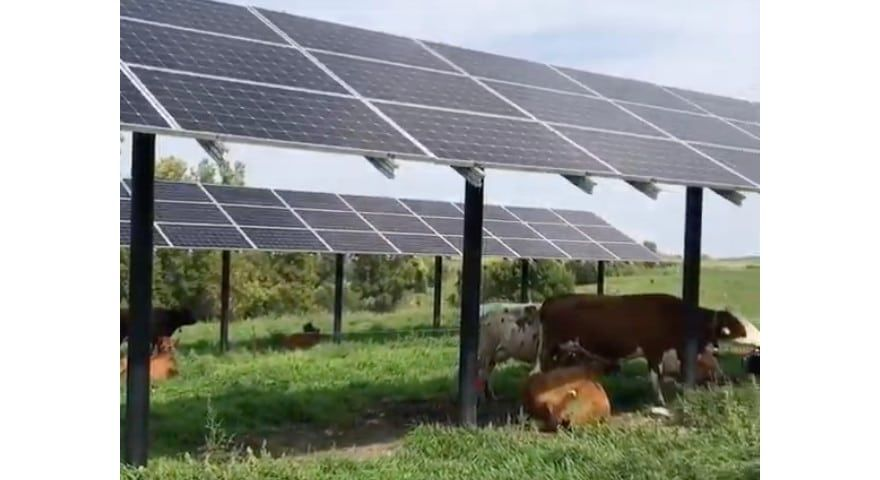
This isn't a compromise. It's an upgrade. Agrivoltaic design means solar panels are elevated high enough for tractors to pass beneath them, livestock to graze under them, and crops to grow alongside them. The farm keeps farming. The solar array powers the data center. And the farmer earns income from both — often more than six times what traditional land rental would pay.
The Agrivoltaic Advantage
What Agrivoltaics Does: Why It Matters
- Solar panels elevated 8–10 ft over crops or pasture...................................................... Tractors can pass underneath — farming continues without interruption,
- Partial shade benefits heat-sensitive crops ......................................................... Blueberries, herbs, and specialty crops thrive — Georgia leads the nation in blueberry acres
- Sheep and livestock graze under the panels .............................................................. Natural vegetation management with no diesel mowers, plus additional farm income
- Dual land use = dual revenue ................................................................... Farmers earn solar lease income and continue earning from agriculture on the same land
- Cooler microclimates reduce irrigation needs ................................................................. Improved soil moisture retention and lower water costs over time
- No RoundUp. No corporate monoculture .................................................................... Small-farm produce, uncontaminated livestock, and chemical-free land — for good
The Data Center Advantage
• Rural sites face far less community opposition than urban or suburban placements — which means faster permitting and fewer delays.
• Behind-the-meter solar can power hyperscale data centers and come online in 18 to 24 months — well ahead of gas (which carries a 3–4 year backlog) or nuclear.
• Georgia and the Carolinas offer abundant sunshine, established fiber connectivity corridors, and pro-business tax policy that make them ideal for this kind of infrastructure.
• Lower land costs translate directly into lower total infrastructure costs — a real advantage in a capital-intensive industry.
Agrivoltaic Site Development
Finding the right land for a solar-powered data center isn't just a real estate decision — it's an agricultural one, a community one, and an energy one, all at once. We identify and develop rural sites across Georgia, North Carolina, and South Carolina that maximize solar yield while actively preserving farm operations. From initial land assessment and soil evaluation to permitting support and stakeholder coordination, we manage the full development journey from first conversation to shovel in the ground.
Our team understands this region. We know which counties are open to this kind of development, which corridors have fiber infrastructure nearby, and which farming families are looking for a new way to make their land work harder. If you're a landowner, a developer, or an enterprise client looking to secure a site, we'll help you move from concept to construction without the friction that derails most projects.
Solar-Powered Data Center Construction & Operation
This is paragraph text. Click it or hit the Manage Text button to change the font, color, size, format, and more. To set up site-wide paragraph and title styles, go to Site Theme.